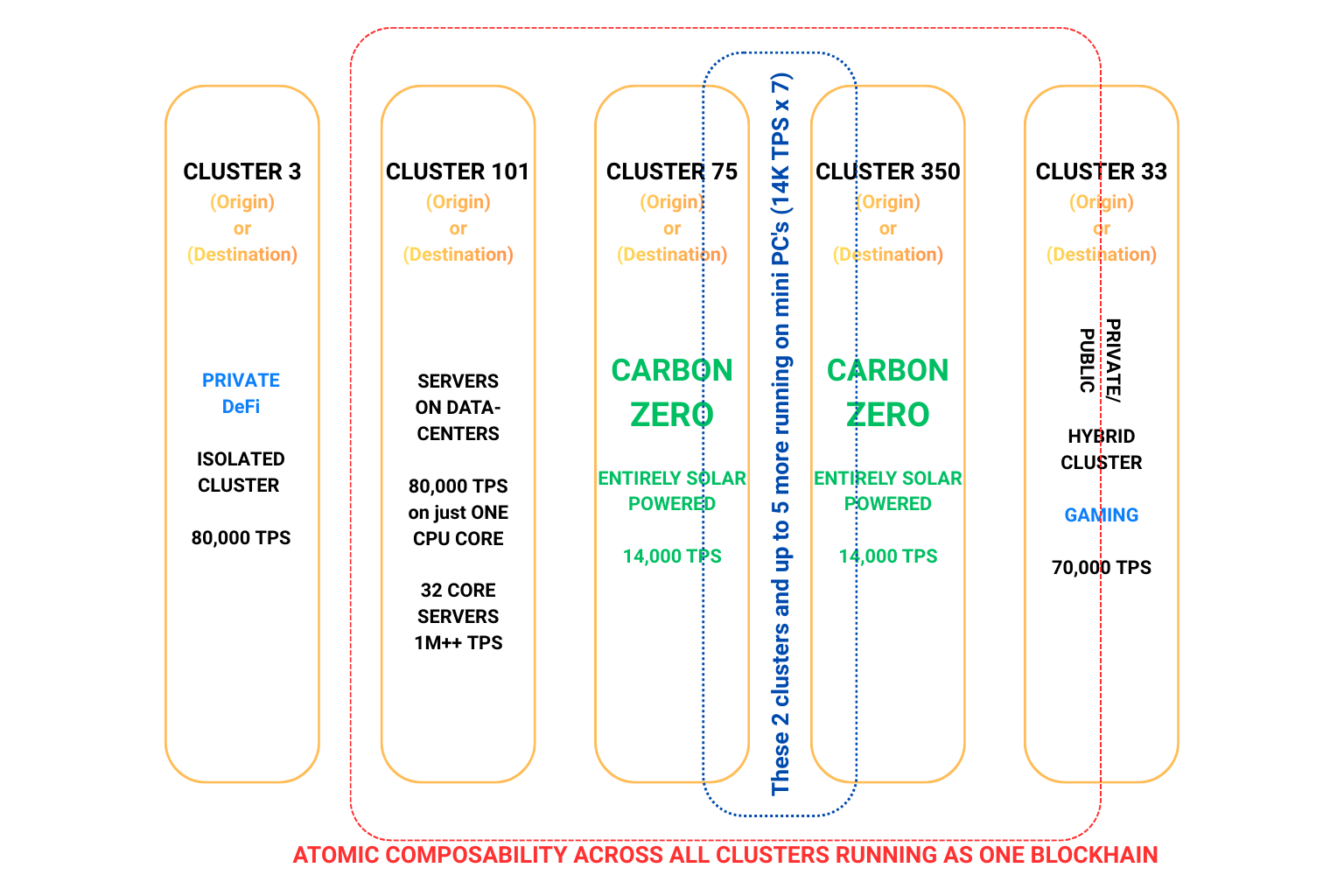
ITZA introduces a fundamentally new Layer-1 design based on 65,536 independent clusters, each functioning as a complete blockchain in its own right. Unlike monolithic chains that force all transactions through a single ledger, ITZA splits workload across tens of thousands of clusters operating in parallel. Every cluster acts as a full L1 blockchain, with its own ledger/state, its own local validator set and consensus, its own transaction mempool and fee market, and even the ability to set local governance parameters. In essence, ITZA is 65,536 coordinated L1s under one network umbrella - an unprecedented degree of parallelism.
This architecture enables true horizontal scaling. Because each cluster handles only a slice of total network traffic, no single validator or node needs to process the entire global throughput. Resource requirements per node are dramatically reduced, allowing localized or project-specific deployments (e.g. a cluster per region or application) without burdening the entire network. Clusters can even be tuned for different performance targets - for example, a cluster run on a Raspberry Pi might handle a few hundred TPS, while one on a data-center server could process hundreds of thousands TPS. As more clusters come online, total network capacity increases linearly, with aggregate throughput theoretically in the millions of TPS. This is true horizontal scalability: the network scales by adding clusters (and their validators), rather than by pushing single-chain performance limits.
Crucially, clustering in ITZA does not sacrifice decentralization or security. Each cluster maintains its own consensus (a "cluster-local" consensus) with a rotating leader schedule and independent validator quorum. There is no "super-validator" or coordinator serializing all clusters; they operate concurrently yet remain part of one network. By sharding the state and transaction load but not the security model, ITZA avoids any single chokepoint. In fact, cluster isolation can increase security: issues or heavy loads in one cluster do not spill over to others. And because 65k clusters operate in parallel, the network has no global throughput bottleneck - capacity grows as needed by simply utilizing more clusters.
In summary, ITZA's architecture is a massive array of parallel L1 chains that together form one blockchain network. Every cluster has: (a) its own ledger and state, (b) its own validators and block production schedule, (c) a self-contained fee economy and execution environment, and (d) localized governance if desired. Yet all clusters share the same underlying protocol and are interoperable at a deep level (as we'll see), which makes the user experience unified. This design stands in stark contrast to earlier "sharding" attempts that often suffered from coordination overhead or limited shard counts. ITZA's 65,536 clusters provide virtually unbounded scalability with full L1 functionality on each cluster.
A centerpiece of ITZA' s innovation is its wallet addressing and routing algorithm, which deterministically assigns each wallet (account address) to one specific cluster at the moment the address is created. In ITZA, there is no need for any central directory or lookup to know which cluster holds a given account's balance or smart contracts - the address itself encodes that information. This is a stateless, algorithmic routing scheme: given an address, anyone can calculate which cluster is responsible for it, purely via a formula (e.g. based on certain bits of the address or a hash), with no network query required.
This means users can generate ITZA addresses offline - even on paper or air-gapped devices - and immediately know which cluster that address will live on, without asking any server[5]. The routing is deterministic and fixed at generation time[6]. For example, a user could decide to create a wallet on a European cluster or a gaming-specific cluster simply by choosing an appropriate address prefix, all done offline. There is no centralized router, no dynamic shard assignment, and no global mapping table to maintain. The algorithm itself is built into the protocol. This approach eliminates an entire class of complexity that has plagued other sharded systems, where one often needs coordination to map accounts or contracts to shards.
The benefits of ITZA's stateless routing are significant: - Predictable Scaling: As usage grows, new addresses naturally distribute across the 65k clusters by algorithm, preventing any single cluster from hot-spotting. Because the mapping is predetermined, the network can scale out predictably without manual rebalancing or complex directory services. - Instant Onboarding: A new user can create a wallet and immediately know their "home cluster". There's no waiting on the network to assign a shard or on any centralized entity to issue an address. This allows seamless user experiences - for instance, an app can generate user addresses and be confident about which cluster to interact with, even if the network is offline at that moment. - No Single Point of Routing Failure: Since routing is an inherent property of the address, there's no load or vulnerability around a central router. Traditional sharding designs often contemplated a coordinator or lookup service for cross-shard transactions (to find where an account lives), introducing latency and risk[7]. ITZA avoids this entirely; the address itself is the route. - Offline Determinism: Organizations can pre-generate batches of addresses assigned to specific clusters (e.g. a company might decide to deploy its dApp on cluster #500 and pre-create all user addresses on that cluster). This can even enable private cluster environments - e.g. a corporate or test cluster - where addresses are known in advance, yet still compatible with the wider network's addressing scheme.
In summary, ITZA's wallet-to-cluster routing is transparent and deterministic. Every address inherently "knows" its cluster, and anyone else can derive it too. This clever design achieves sharding of accounts without any stateful directory. It's a significant usability win over earlier multi-chain systems which often required users to manually select networks or rely on relays - here the complexity is abstracted away by the address format. From a scalability perspective, this provides frictionless, automatic distribution of load across clusters as the user base grows, with zero overhead for discovery. It is a "set-and-forget" approach to sharding: once an address is set, its cluster is fixed and known, simplifying all subsequent interactions.
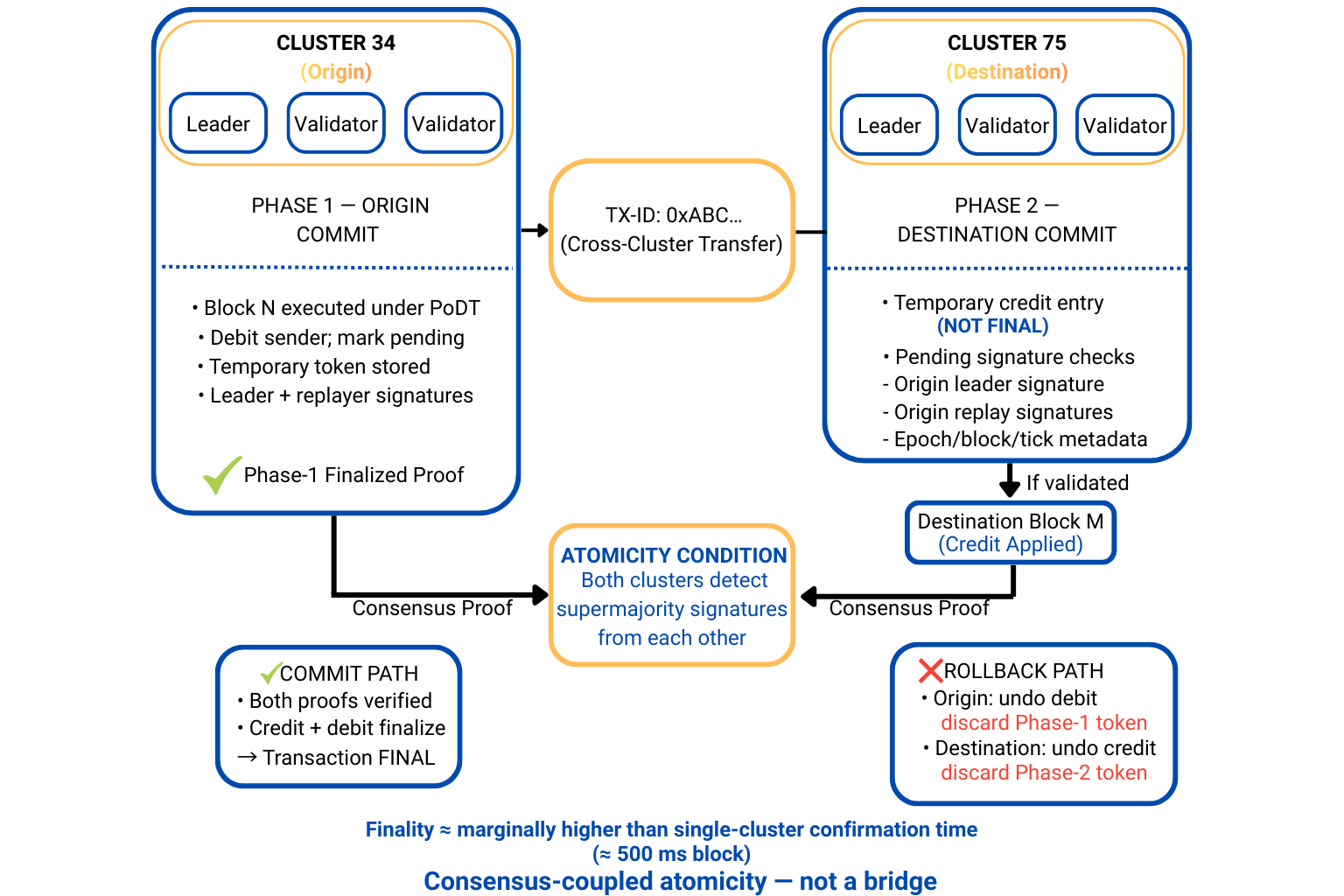
Perhaps ITZA's most groundbreaking feature - and the hardest to achieve in prior blockchains - is its atomic cross-cluster transaction protocol. In traditional terms, this is analogous to a distributed two-phase commit across multiple databases; in ITZA's case, it allows a single transaction to span multiple clusters while guaranteeing all-or-nothing execution. If a transaction touches, say, cluster #100 and cluster #42, ITZA ensures that either both clusters commit the changes, or both abort - there is no partial completion. This happens within one unified, synchronous operation that feels to the user like a normal transaction, completing in a fraction of a second[3].
Achieving synchronous atomicity across independent blockchains has long been a "holy grail" of blockchain design, something that no other network has successfully implemented at scale. Competing multi-chain ecosystems typically rely on asynchronous message passing or non-atomic bridges, meaning cross-chain interactions are slow, complex, and carry risk of one side failing without rollback (more on that in comparisons). ITZA's protocol, by contrast, delivers seamless composability across clusters - a smart contract on cluster A can call another on cluster B within the same transaction, with full atomic guarantees. From the developer or user perspective, all clusters behave like one integrated ledger when it comes to transactional composability. This is a huge breakthrough for decentralized applications: it means that sharding does not break DeFi composability or user experience. Any combination of actions across any clusters can be packaged into one logical transaction, preserving the powerful atomic composability that Ethereum L1 dApps enjoy within a single shard[3].
While the exact implementation details of ITZA's cross-cluster commit are proprietary, the fundamentals likely involve a coordination protocol among the clusters' validators. One can imagine a two-phase commit: in phase 1, all involved clusters' validators pre-validate and lock the transaction's intent; in phase 2, they either all commit or all rollback based on a final coordination message. What's important is that this occurs transparently and quickly - ITZA achieves cross-cluster finality within the timeframe of a normal block confirmation (fractions of a second)[3]. There is no waiting for minutes for one chain to notice an event on another, as is common with cross-chain bridges. ITZA's protocol is synchronous, meaning clusters communicate during block production to finalize the outcome together. If any part fails (say one cluster's part of the tx can't execute), the entire transaction is aborted universally - maintaining ACID semantics (Atomicity, Consistency, Isolation, Durability) across clusters[8][9].
Notably, ITZA's atomic commit is rollback-capable. This is key: if an inter-cluster transaction cannot proceed on one cluster (due to failure, insufficient funds, etc.), ITZA will rollback any tentative changes on all clusters. Thus, the network state remains consistent - you will never have a situation where tokens are debited on cluster A but not credited on cluster B, or a contract calls one side succeeded while the other side hung. It's truly all or nothing. This property unleashes powerful use-cases: - Cross-Cluster DeFi: For example, a user could atomically swap an asset on cluster X for an asset on cluster Y in one step. Or a complex operation could atomically utilize liquidity pools that reside on different clusters. All of DeFi's money legos can extend across clusters without introducing "bridge risk" or timing uncertainty. - Multi-Cluster dApps: Composable smart contracts can be distributed for load balancing (each cluster might host a module of a dApp), yet they can interact as if on one chain. ITZA's commit protocol ensures a function call spanning clusters either fully succeeds across all or fails gracefully, maintaining application logic integrity. - Simplified User Experience: Users do not have to manually move assets between clusters or handle failure scenarios - a single transaction just works, or reverts entirely. This is something even Ethereum's upcoming sharding or L2s won't do; Vitalik Buterin has noted that synchronous atomic composability across rollups is not guaranteed in Ethereum's roadmap[10].
In short, ITZA solved a problem that stumped previous designs: how to have many parallel chains without losing the ability to perform atomic, synchronous operations across them. The cross-cluster commit protocol is a first-of-its-kind solution making ITZA's myriad clusters feel like one cohesive platform from the standpoint of execution. It is a major technical differentiator - no other blockchain network (sharded or multi-chain) has effectively delivered this level of cross-chain atomicity in practice. Projects like Radix have proposed similar atomic cross-shard consensus algorithms (e.g. Cerberus) in theory[11], but to date none are operational at ITZA's scale. ITZA's accomplishment here positions it as a truly next-generation L1, combining unlimited scale with unified composability.
Many blockchain projects have attempted to solve scalability via sharding or multi-chain architectures - none have achieved the level of horizontal scalability and seamless composability that ITZA offers. Below is a comparison of ITZA's design to several major platforms:
To summarize the competitive landscape: ITZA is the first to achieve true horizontal scalability (through many parallel clusters) combined with synchronous atomic execution across those clusters. Other approaches have either: stayed single-chain (Solana, Sui, Aptos) and hit scaling/cost or composability limits, introduced multiple chains but with asynchronous communication and limited shared security (Polkadot, Cosmos, Avalanche), or theorized atomic sharding but haven't delivered it yet (Radix, perhaps Shardeum in progress). None of the existing major platforms provides the combination of unlimited parallel throughput and unified composability that ITZA does. This positions ITZA in a category of its own. In the next section, we enumerate the concrete benefits that derive from this novel architecture.
ITZA's unique clustered architecture yields multiple compelling benefits:
In summary, ITZA's approach yields a network that is infinitely scalable, highly decentralized, and user/developer-friendly. It achieves the performance to support mass adoption (high throughput, low fees), the consistency to preserve the composability and security developers rely on, and the inclusiveness to let anyone participate (both as users and validators) without needing complex add-ons. It's a holistic solution that addresses the shortcomings of previous generations, which leads us to examine why those earlier attempts fell short and how ITZA avoids their pitfalls.
Despite years of research into sharding and multi-chain architectures, earlier systems struggled with a set of inherent challenges. ITZA's design was consciously engineered to avoid these pitfalls. Here are the key reasons previous systems failed to achieve true horizontal scalability, and how ITZA's approach differs:
Global Consensus Bottlenecks: In many sharded designs, a central coordinator or global consensus layer limited throughput. For example, Ethereum's vision of sharded execution would still have all shards finalized by one beacon chain, and Polkadot's parachains all report to a single relay chain for finality. This creates a bottleneck at the top of the hierarchy - no matter how many shards you add, the relay/beacon must process all their state (or at least all proofs). This caps scalability and can lead to congestion at the base layer. ITZA avoids this by eliminating any sort of single "master chain." Each cluster finalizes blocks on its own with no global serialized chain of all transactions. There is no equivalent of a relay chain that must run every transaction; clusters only sync when needed for cross transactions, and even then, only concerned clusters coordinate. This massively parallel approach removes the choke-point of a global sequential consensus, which is why ITZA can truly scale out. The network can process many blocks (one per cluster) simultaneously every second, rather than one block at a time like traditional chains[20].
Asynchronous Cross-Chain Communication: Almost all multi-chain ecosystems before ITZA relied on asynchronous messaging for cross-chain interactions. Whether it's Polkadot's XCM, Cosmos's IBC, or generic bridges, the pattern is: one chain emits a message or locks funds, then (often after some delay or via third-party relays) another chain picks it up and proceeds. This model is non-atomic - if something goes wrong on the destination chain, the source chain might not roll back automatically. It also introduces latency (finality on one chain plus on the other) and complexity in programming (developers have to handle retries, acks, timeouts). For instance, an analysis of Polkadot's XCM noted it "does not lock the state of chains together," meaning it cannot guarantee an all-or-nothing outcome[13]. Similarly, bridging tokens between chains often involves minutes of confirmation and risk of one side being hacked or misbehaving. ITZA's answer is synchronous, atomic commits across clusters - effectively treating cross-cluster operations as a single logical transaction. This is a monumental shift: it guarantees consistency (no half-done multi-chain ops) and simplicity (developers don't have to write complex state reconciliation logic). By building atomic cross-chain execution into the L1, ITZA removes the fragility and slowness of asynchronous designs[14]. No more manual bridge transfers or waiting for finality on chain A before acting on chain B - ITZA does it in one step.
Governance and Deployment Friction: Many previous scaling solutions required heavy governance intervention or cumbersome deployment processes to actually use the scale. Polkadot, for example, initially limits parachains and requires projects to bid for slots, meaning scaling is literally rationed by governance and capital[22]. If demand exceeds 100 parachains, too bad - you're stuck unless governance increases it (a slow, untested process). Similarly, launching a new Cosmos zone or Avalanche subnet is effectively launching a new blockchain - you must recruit validators, possibly issue a token, and so forth. These frictions significantly slow down adoption and negate the "easy scaling" narrative. ITZA, on the other hand, comes with 65,536 clusters out-of-the-box, all ready to use. No auctions, no separate token for each cluster, no permission needed. If your dApp needs capacity, you simply start using an existing cluster (or multiple clusters). There's no concept of "winning a slot" or bootstrapping a whole new chain's security. This frictionless availability of clusters means ITZA can scale usage organically. Developers and communities don't have to negotiate with the base protocol to get space - the space is there and waiting. Governance in ITZA is cluster-local (each cluster can have its own proposals for parameters), avoiding entangling the whole network for one shard's issues. Overall, ITZA removes bureaucratic and logistic impediments to scaling that earlier designs inadvertently imposed.
Poor Determinism in Shard Assignment: A subtle but important issue in some sharded proposals is how data (accounts, contracts) get assigned to shards. If this process is dynamic or opaque, it introduces uncertainty and overhead. For instance, if a contract on Ethereum needed to call another on a different shard, how would it know which shard? Some designs contemplated directory contracts or cross-shard name services, which add complexity. Others, like some Ethereum 2.0 proposals, would assign accounts to shards by some hash but then need "rendezvous" mechanics for cross-shard calls. These approaches are complicated and can hurt developer experience. ITZA solved this by its stateless deterministic routing of wallets to clusters. The cluster of any address is known immediately from the address itself[6]. There's no ambiguity or runtime lookup. This determinism extends to contract addresses as well (since they live at an address on a cluster). So in ITZA, everyone knows exactly where any piece of state resides. There's no need for a global state directory or shard lookup service. This greatly simplifies cross-cluster interactions (the protocol knows exactly which clusters need to coordinate) and reduces error. No previous system had such an elegant deterministic shard assignment - for example, Shardeum (a newer project) uses a more involved routing with coordinator nodes and routing tables for cross-shard transactions[7], indicating the added layers others require. ITZA's approach is lean: the address scheme itself encodes cluster location. This is a key enabler for its efficiency.
Lack of Atomic Execution Across Shards: This is partly covered under asynchronous communication, but to emphasize: one of the biggest reasons earlier sharded blockchains failed to gain DeFi traction is that they could not execute complex multi-contract transactions atomically across shards. For example, imagine trying to do a flash loan on shard A, use it on shard B, and pay back on shard A - with typical sharding, that's impossible to do in one atomic transaction; you'd have to break it into pieces and accept risk at each step. This global atomic execution was absent, essentially breaking composability and many advanced use-cases. Ethereum's Merge and sharding plans explicitly side-step this by focusing on L2s, effectively accepting the loss of atomic composability across rollups[23]. Polkadot and Cosmos also lack atomic cross-chain execution as discussed. ITZA squarely addresses this with its atomic commit protocol. Therefore, it overcomes the "composability trade-off" that others made. This is arguably the single most important feature for preserving DeFi and complex dApp viability in a scaled environment. Without it, sharded systems end up with silos of functionality - with it, ITZA retains the unified global state abstraction for developers, even though under the hood it's distributed. That is a decisive advantage.
High Validator Complexity and Costs: Many prior L1s that attempted higher throughput ended up demanding a lot more from validators. Solana is a prime example - to keep up with its firehose of data, validators need very high-performance machines and lots of bandwidth/storage. This raises centralization concerns (only well-funded entities can run nodes) and also practical network limits (can't exceed what the best nodes can handle). Sharded systems also can be complex for validators: in some designs, validators had to validate multiple shards or shuffle between shards frequently (which can be resource-intensive and complicated). Polkadot's validators rotate through parachains and have to run the logic of any parachain at a given time, which means effectively all validators must have the capability to validate any parachain's code - a non-trivial requirement. Avalanche requires anyone validating subnets to also validate the main network, adding to workload. All these factors make running a node harder. ITZA drastically reduces validator complexity by localizing validation to clusters and keeping requirements modest. Validators don't need to concern themselves with the entire network's state - they focus on their cluster(s). Even when cross-cluster consensus occurs, it's a focused coordination among just the involved clusters' validators, not the whole network. ITZA's use of a hybrid consensus (mentioned as Proof-of-History + PoS deterministic timechain[24]) further improves efficiency, so validators aren't grinding on expensive PoW or running massive resource loads. The outcome is a lighter, more sustainable validator load, meaning more individuals can run nodes (increasing decentralization) and the network can grow without outpacing its validators' capabilities. By designing for "residential grade" nodes from the start[25], ITZA avoids the trap of requiring ever-more-powerful hardware that afflicted other high-TPS chains.
In essence, ITZA's architecture was crafted as a direct answer to the known failure modes of blockchain scaling. Where others introduced central bottlenecks, ITZA stays fully distributed; where others required asynchronous workarounds, ITZA built-in synchronous solutions; where others became complex or exclusive, ITZA remains simple and inclusive. The end result is a network that achieves the long-sought triad of scalability, decentralization, and composability. It doesn't compromise one for the other, due to these careful design choices. This strategic advantage sets the stage for ITZA's positioning in the market.
ITZA emerges as the first Layer-1 blockchain to offer truly linear horizontal scaling without sacrificing synchronous execution or user/developer experience. This positions ITZA in a league of its own - effectively a "Web-Scale" blockchain platform ready for mainstream adoption and the next wave of decentralized innovation. From an investor or industry perspective, ITZA's key strategic advantages include:
First-Mover Advantage in Horizontally Scalable L1: While many protocols talked about sharding, ITZA is delivering a working network with 65k clusters and atomic cross-cluster execution. This is akin to being the first cloud provider to offer horizontal scaling vs. competitors stuck on single-server models. The technical moat here is significant; ITZA Labs has solved problems others have only theorized about. As the "final form of blockchain" in their words, ITZA could set a new standard that other projects will take years to catch up to[26][27]. Being first means ITZA can attract the developers who need high throughput now and capture the applications that cannot run on other L1s.
Unified Platform (No Need for L2s or Alternative Chains): ITZA can credibly position itself as a one-stop solution for all decentralized application needs. Projects won't have to launch on Ethereum then later migrate to an L2 for scaling (splitting liquidity/security), nor will they need to build app-specific chains and struggle with interoperability. With ITZA, a project can start on one cluster and, if it needs more capacity, seamlessly expand to use multiple clusters - all while remaining in one network with one set of security assumptions. This makes ITZA very attractive for ambitious Web3 applications (think social media dApps, global gaming platforms, high-frequency trading, etc.) that would hit a wall elsewhere. Strategically, ITZA can market itself as "the last blockchain you'll ever need" - capable of accommodating growth to internet-level scale without changing networks.
Synchronous Atomic Execution as a Differentiator: In a multi-chain world, ITZA stands out by offering the ease of cross-contract composability that developers love about Ethereum, but across a limitless scale. This is a huge selling point to DeFi developers and others who are worried that moving to sharded or multi-chain systems will break their composability. ITZA says: you can have your cake and eat it too - unlimited scale and preserve atomic composability. This one-two punch is something no other competitor can claim (Radix might in the future, but ITZA is doing it now). Strategically, this could attract liquidity and DeFi activity to ITZA, as protocols realize they can operate at scale without losing the synergies that currently exist on single-chain ecosystems. It essentially future-proofs DeFi and other complex dApps against the scaling wall.
Cluster-Local Consensus and Consumer-Grade Validators: ITZA's approach can cultivate a vibrant, decentralized validator community globally. By allowing anyone with a modest machine to run a node for a cluster, ITZA lowers entry barriers and avoids miner/mining-pool centralization or stake centralization seen in other networks. This "unapologetically decentralized, fair, accessible to everyone" ethos is not just ideological - it's practically implemented via the cluster design and leader schedule that favors small validators[29]. From a strategic standpoint, this means ITZA can achieve high Nakamoto decentralization (many independent validators), which improves security and regulatory resilience. It can pitch itself as the decentralized scaling solution, countering the narrative that high performance comes at the cost of centralization (as critics often say of Solana or BSC). Additionally, broad network participation can drive community growth and loyalty, as more people have a stake (literally and figuratively) in the network.
Appeal to Enterprise and Web2 Integration: With its scalable and partitionable architecture, ITZA is well-suited to enterprise and Web2 use cases that demand both performance and some level of data/business isolation. Enterprises could leverage ITZA clusters for specific applications (even permissioned clusters that still anchor to the public network for security), knowing they can always interoperate with the public clusters when needed. The ability to have cluster-specific policies (governance, KYC, etc.) while still being on a common network is a strong value proposition. ITZA could position itself as the network of choice for real-world asset tokenization, gaming, social networks, and IoT - domains that need huge scale. Its extremely low fees (due to high capacity) and fast finality make it viable for micropayments and high-frequency interactions in a way legacy L1s aren't.
Longevity and Future-Proofing: Architecturally, ITZA has room to grow. 65,536 clusters is an enormous headroom (far beyond current needs), and even that is a soft limit - if technology improves such that each cluster can handle far more, the network scales accordingly. ITZA does not face the kind of hard trade-offs others will at high load (e.g., Ethereum L1 hitting gas limits, or Solana hitting hardware limits). This gives confidence that ITZA can handle mass adoption without a redesign. Investors and developers can be assured that success on ITZA (lots of users, lots of dApps) will not throttle the network or price out transactions; instead it will simply utilize more of the existing parallel capacity. Essentially, ITZA is built to serve billions, not just speculative early adopters[30]. This strategic messaging - that ITZA can be the foundation of Web3 at world scale - sets it apart from incremental improvements by competitors.
In conclusion, ITZA positions itself as the first horizontally scalable L1 that doesn't compromise on the core blockchain value propositions. It delivers:
For technically sophisticated investors, these points signal that ITZA is not just another iterative blockchain, but a leap forward in architecture. It has identified and solved the major limitations that have so far prevented blockchains from truly scaling (or forced them to rely on kludges like L2s). By doing so, ITZA opens the door to a new class of applications and potentially wider adoption. The network's design reflects a long-term vision: it's built to "unlock the future of digital value" by combining limitless performance with fairness and decentralization[31].
From a strategic standpoint, if ITZA gains traction, it could absorb usage from many niche chains and L2s, since it offers a unified platform for all. Its success would likely pressure other ecosystems to attempt similar feats, but given the complexity, ITZA has a considerable head start and IP. In summary, ITZA is positioned as the first blockchain platform that can genuinely scale to global throughput while remaining one cohesive, composable system. This makes it a prime candidate for both developers seeking the next-generation platform and investors looking for the infrastructure that can support the next wave of blockchain innovation.